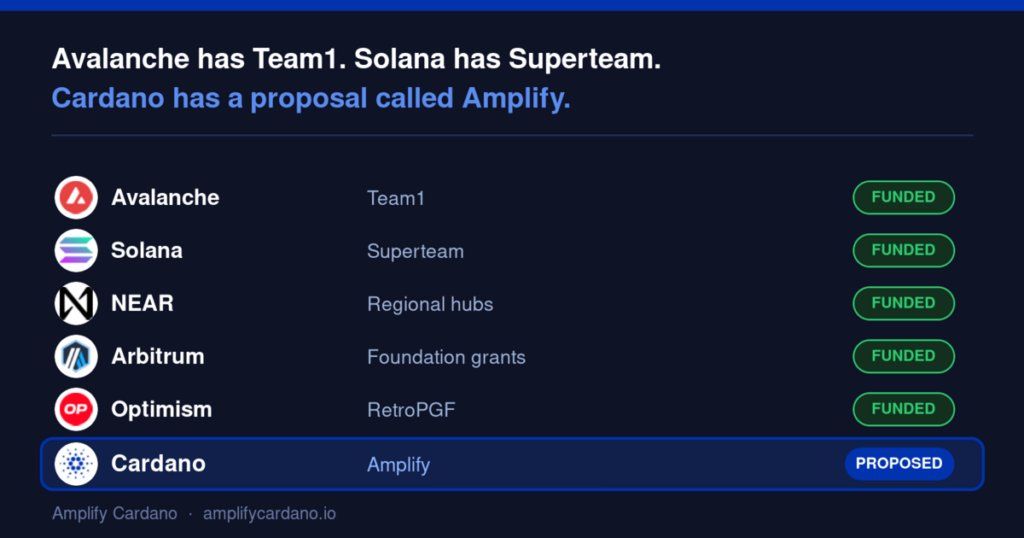
Avalanche has Team1. Solana has Superteam. Cardano has a proposal called Amplify.
The Amplify Cardano vote is live on the Cardano 2026 budget ballot, through June 12. Cast your vote here.
Every other major ecosystem already funds one of these. Cardano doesn't.
A dedicated, named community-growth organization is not an experiment in crypto. It is standard infrastructure on every competing Layer 1, and Cardano is the outlier for not having one.
🔺 Avalanche: Team1
The closest precedent to Amplify. The Avalanche Foundation grew a single community-growth DAO from a $10K starter grant to a major milestone grant in December 2024, funding ambassadors, university outreach, events, content, and builder mini-grants across 56 countries. That is the same mandate Amplify proposes, at the same order of magnitude. (Figures per Team1's own reporting.)
◎ Solana: Superteam
Solana institutionalized grassroots growth through Superteam: nine regional collectives (India, Vietnam, Germany, Nigeria, the UAE, and more), funded via Solana Foundation regional grant programs, plus Superteam Earn, a bounty and grant marketplace with 185,000+ registered users and 2,470+ sponsors. The model is regional, event-driven, and talent-first, which is exactly the thesis behind Amplify's Grassroots Fund.
Ⓝ NEAR: Regional Hubs
The NEAR Foundation funds six regional hubs (Ukraine, Kenya, the Balkans, Vietnam, India, Korea), each staffed with local operators running events and onboarding. That is the same regional-chapter structure Amplify would bring to Cardano.
The DAO-treasury ecosystems reach the same conclusion by a different route: Arbitrum runs committee-led grant domains, and Optimism funds builders retroactively through RetroPGF. Across every model, whether foundation grant, federated chapters, DAO committee, or retroactive funding, the verdict is identical. The connective community-growth layer is worth paying for, and every major ecosystem pays for it.
Cardano's treasury already deploys far more than $2M. What it has lacked is this layer: the regional, grassroots-marketing engine that turns funded projects into onboarded wallets and active DReps. At $2M over 18 months, Amplify is not a novel ask. It is a conservative, peer-validated one, and it is the only entry in this peer set launching with a shipped proof-of-concept already on the books.
The structure under the receipts
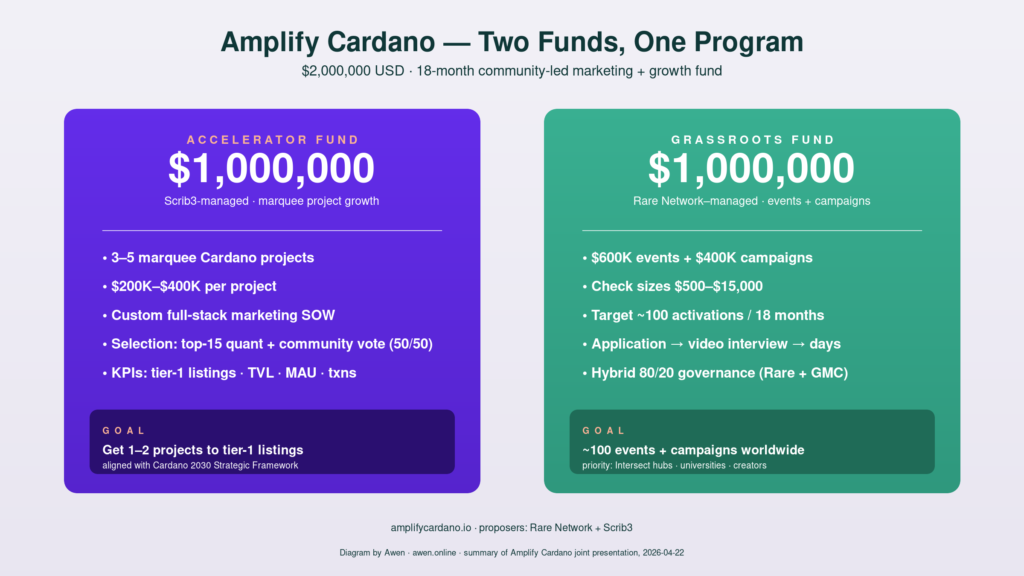
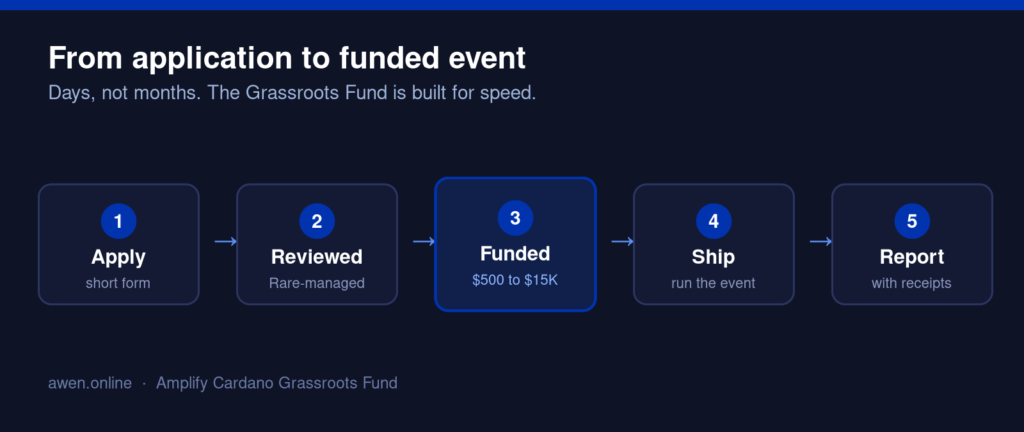
The full Amplify ask is $2M / 18 months, split into a $1M Accelerator Fund (3-5 marquee Cardano projects at $200K-$400K each, Scrib3-managed) and a $1M Grassroots Fund (~100 events and campaigns at $500-$15,000 each, Rare-managed). All five POC events above were run under the latter mechanism.
Go to the source: read the full Amplify Cardano proposal and view the Rare Network / Scrib3 presentation deck this analysis draws from.
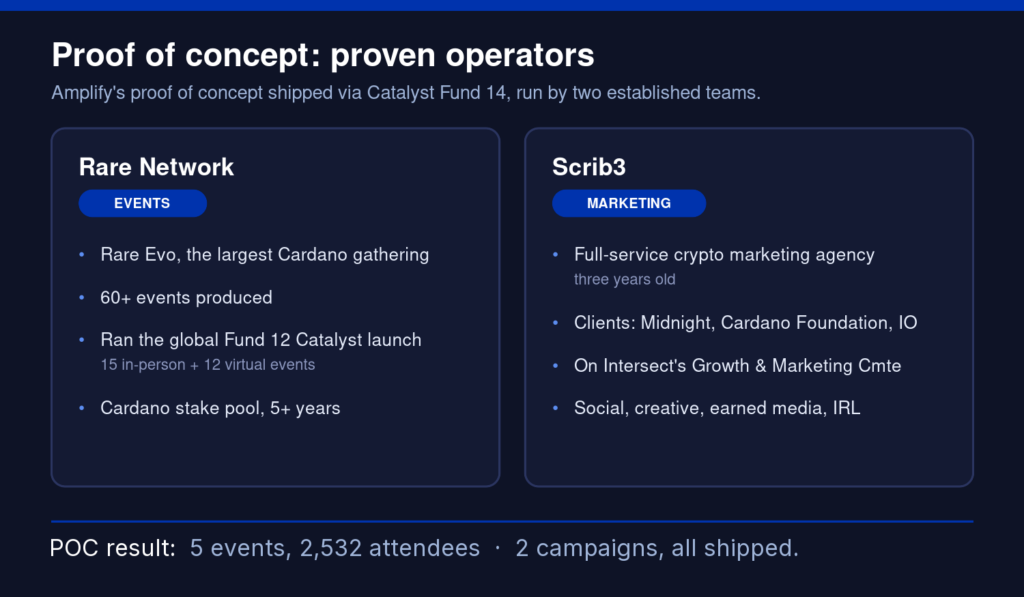
In the last six months, Rare Network and Scrib3 used a Project Catalyst Fund 14 proof-of-concept to ship five community events and two marketing campaigns under the Amplify Cardano framework. All events shipped. Both campaigns shipped. Every event has a public Luma page with confirmable attendee count and sponsor stack.
The five events that shipped
All five ran on Grassroots-tier checks under Project Catalyst Fund 14, each with a public Luma page and a confirmable headcount:
- 🇹🇼 SNEK Den, Taipei: 105 (sold out)
- 🇻🇳 Cardano ADA Wrap-up 2025, Ho Chi Minh City: 95
- 🇭🇰 The Cardano Happy Hour, Hong Kong: 1,692
- 🇭🇰 Web3 Founders Night, Hong Kong: 384
- 🇰🇪 Cardano Hackathon, Nairobi: 256
2,532 registered attendees across five events, plus two campaigns: a USDM card-handout drive (2,000+ new wallets) and the Raiders Guild social push (~5,000 engagements, ~400,000 impressions).
The cost-per-touch math, with real numbers
Project Catalyst Fund 14 awards in the community-events category typically ranged from $5,000-$25,000 per project. Assuming a midpoint of $10,000-$15,000 per activation across the seven shipped activations (5 events + 2 campaigns), the proof-of-concept total spend is on the order of $70,000-$100,000.
Touchpoints delivered: 2,532 attendees + 2,000+ new wallets + ~5,000 social engagements ≈ 9,500+ verifiable points of contact, plus 400,000 impressions for top-of-funnel reach.
That comes out to a blended cost-per-touch of roughly $7-$10 across attendees + wallets + active engagements. For the wallet sub-segment specifically, the math is even tighter: if half the program spend went to the USDM campaign, that's $18-$25 per new on-chain wallet; if a quarter, $9-$13.
Paid-acquisition benchmarks run far higher, as the framework below shows.
How DReps should measure on-chain impact
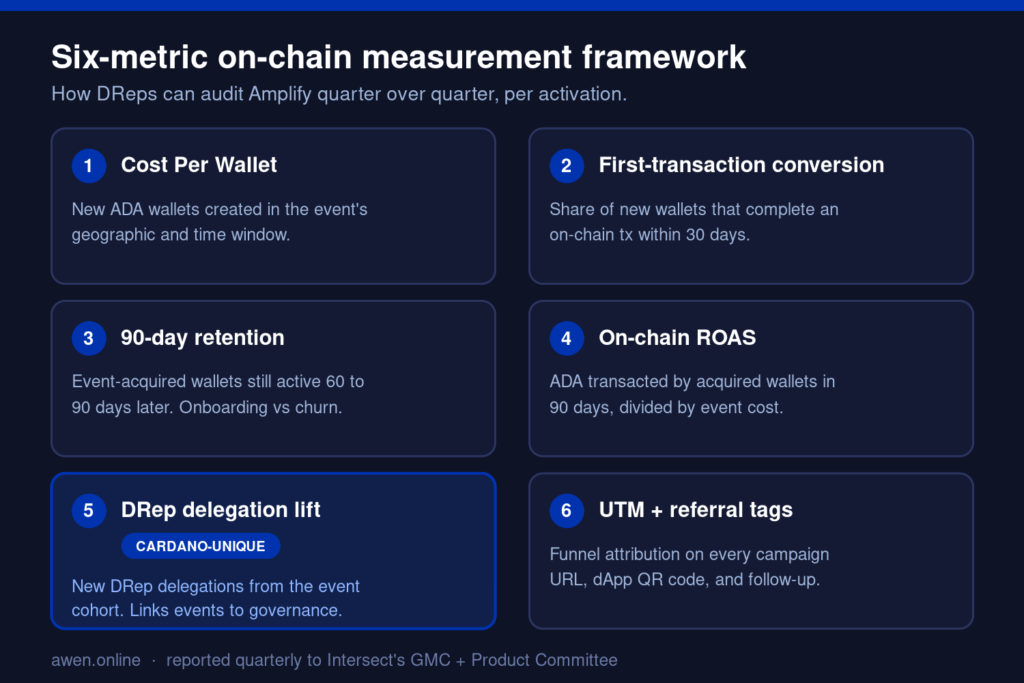
The legitimate DRep concern: how does roughly $20K per activation translate into measurable on-chain growth, and how do we audit whether to renew Amplify in Round 2? What follows is a falsifiable framework. Each metric is a formula, with the data window it draws from, run against the proof-of-concept numbers.
Notation. For an activation or program window:
- C = cost in USD
- W = new ADA wallets created in the event's geographic and temporal window
- Wtx = wallets that complete at least one on-chain transaction within 30 days
- W90 = wallets still active at 60-90 days
- V90 = ADA value the cohort transacts within 90 days
- A = attendees
- E = verified social engagements
- D = DRep delegations from the cohort
1. Cost per wallet
CPW = C / W
POC: the USDM drive opened 2,000+ wallets. If a quarter of the $70K-$100K program spend drove it (~$18K-$25K), CPW ≈ $9-$13; if half, CPW ≈ $18-$25.
2. First-transaction conversion
k1 = Wtx / W
Separates a funded wallet from a live one. A healthy onboarding cohort targets k1 ≥ 0.40 within 30 days.
3. Ninety-day retention
R90 = W90 / W
The churn test, distinguishing real onboarding from one-touch airdrop tourism. A program that reports R90 activation by activation is auditable; one that reports only signups is not.
4. On-chain ROAS
ROAS = V90 / C
Best-in-class L2 DEX campaigns hit 1.7× in 14 days. A cohort of real participants reasonably benchmarks at 2×-4× over 90 days, because the wallets are people who showed up rather than ad impressions.
5. DRep delegation lift, the Cardano-only metric
ΔD = Dafter − Dbefore
Net new DRep delegations from wallets in the event's geographic cohort. No other Layer 1 can report this. It ties a community event directly to governance participation, which for a treasury-funded program is the single most important number on the page.
6. Blended cost per touch, program level
CPT = C / (A + W + E)
POC, run end to end: C ≈ $70K-$100K over (2,532 attendees + 2,000 wallets + ~5,000 engagements) ≈ 9,500 verifiable touchpoints, so CPT ≈ $7-$10, an order of magnitude under paid-acquisition rates.
The mechanism. Amplify's required quarterly reporting to Intersect's GMC and Product Committee should publish metrics 1 through 5 per activation. Aggregated across 100+ activations over 18 months, that is a governance-grade dataset, the kind of evidence DReps can use to renew Amplify in Round 2 or reject it on the math.
Methodology and sources. These six metrics adapt established marketing and growth measures, cost per acquisition (CAC), activation and retention rates, return on ad spend, incrementality, and cost per engagement, to on-chain, wallet-level data. The benchmark figures cited (for example, a Layer-2 DEX reaching roughly $3 cost-per-wallet and 1.7× on-chain ROAS within a 14-day window, with wallet conversion typically 2-4%) are drawn from published Web3 user-acquisition reporting (Blockchain-Ads, 2025-2026; HypeLab). The activation target (k1 ≥ 0.40) is an onboarding-health heuristic, not a published industry figure.
What Amplify could mean for your event, project, or brand
Amplify funds two tiers, so "a good spend" looks different depending on where you sit.
Run events or community? (Grassroots Fund, $500-$15,000.) This is the tier that powered all five proof-of-concept events. A regional meetup, hackathon, or policy night gets covered the way SNEK Den, the Nairobi hackathon, and the Ho Chi Minh City wrap-up were, venue and speakers and onboarding included, without organizers fronting the cost out of pocket. Apply, ship, report.
Building a marquee project? (Accelerator Fund, $200K-$400K.) Dedicated, Scrib3-managed marketing and growth support for three to five standout Cardano projects, the kind of campaign muscle most teams cannot staff in house.
Sponsor or brand? A vetted, on-chain-measured event network across dozens of regions, putting your name in front of real, verified Cardano audiences at a blended cost-per-touch of roughly $7-$10, not paid-ad rates.
The vote is live
Amplify Cardano is on the Cardano 2026 budget ballot right now, and voting is open through June 12. If you hold ADA and have a DRep, this is the window that decides it.
- Vote now. Cast your vote on the Cardano 2026 budget here: hydra-voting.intersectmbo.org. Open through June 12.
- Read the full proposal. The complete proposal and the Rare Network / Scrib3 presentation deck lay it out in full; the structure, governance, and KPIs are summarized at amplifycardano.io.
- Plan to apply. If Amplify passes, the Grassroots Fund opens to organizers. Line up your event now.