Three ways to license music on Sync.Land, starting with free
At a glance
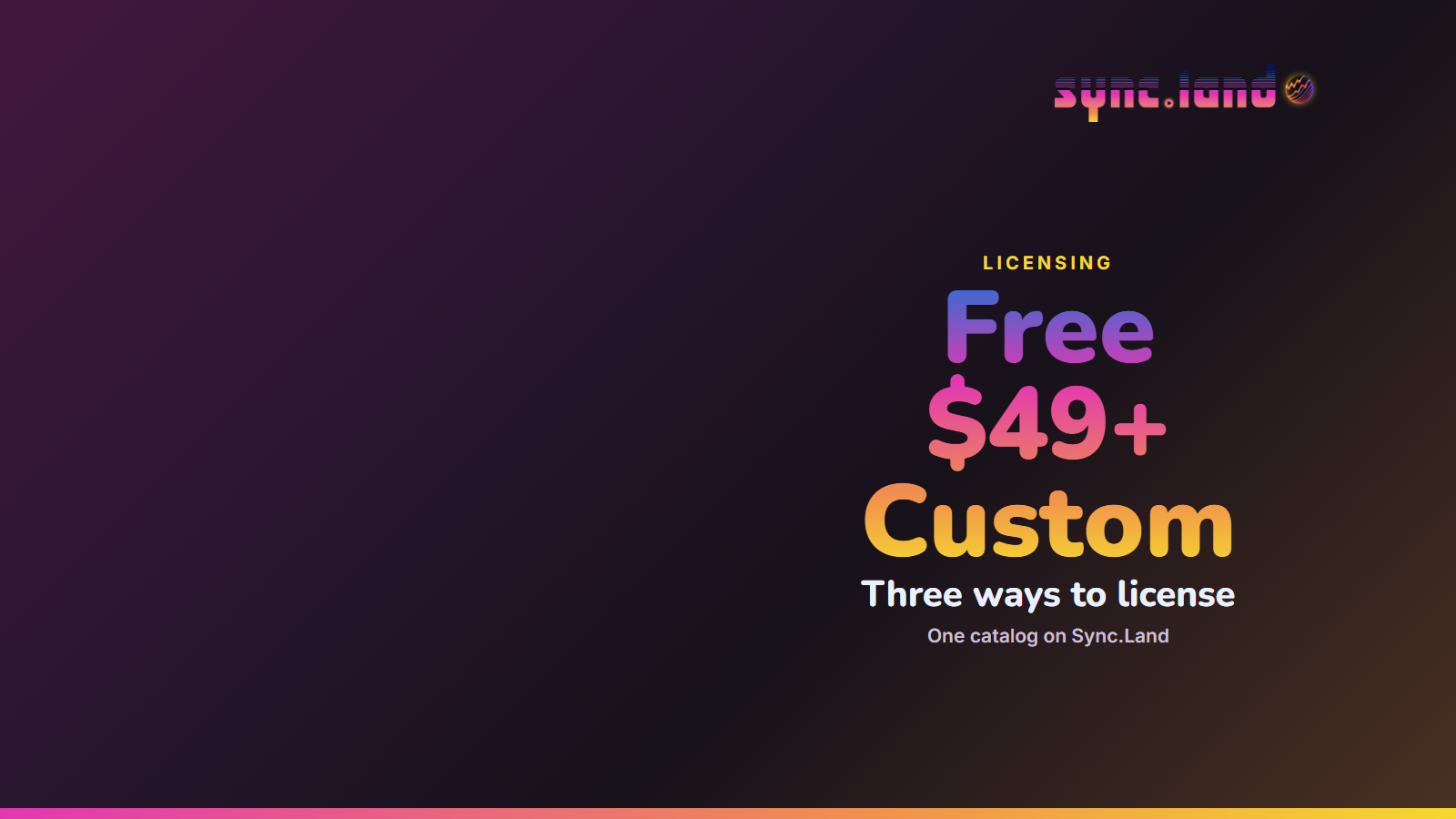
- Free Sync License: free with an account, for personal, education and non-profit work and for creator content up to 100,000 views. Credit to the artist is required.
- Commercial Sync: from $49 per song, set by the artist. One payment covers the project for good.
- Custom and exclusive: negotiated directly, for broadcast, theatrical film, major ad campaigns and similar uses.
- Every license: comes with a PDF certificate and a public verification page.
- Where: sync.land/licensing
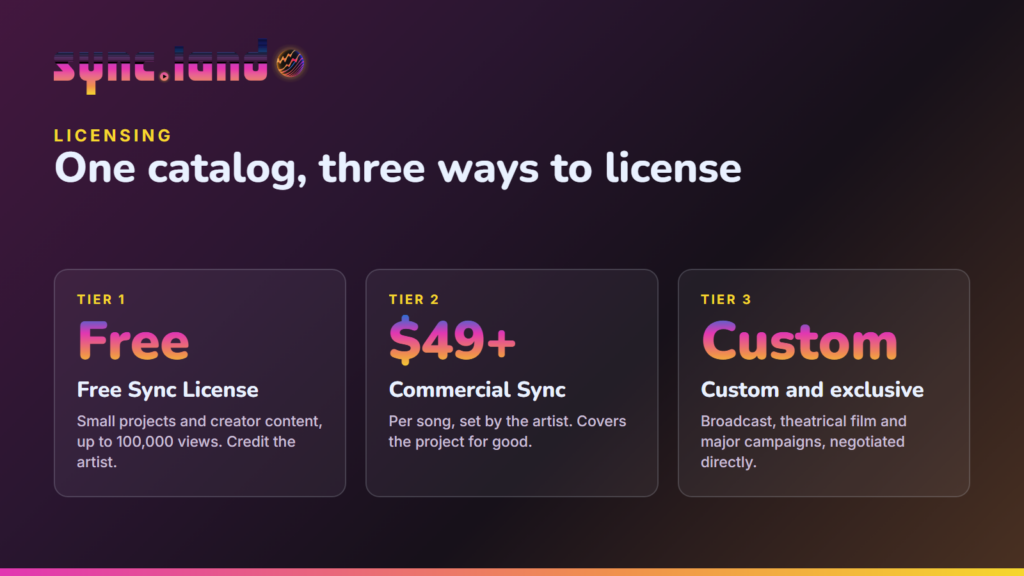
Sync.Land, our marketplace where independent artists license music directly to people who make video, games, podcasts and streams, now has three license tiers on one catalog. The current Free Sync License terms are version 1.2, dated September 27, 2026.
The Free Sync License
The free tier needs a free account and no credit card. It covers:
- personal, education and non-profit projects
- creator videos on YouTube, TikTok, Reels and Twitch
- independent podcasts with a public feed
- game jams and open-source game builds
- live streams played through the Sync.Land player
You download an MP3 and a PDF certificate, and you credit the artist everywhere the project appears.
What happens when a project grows
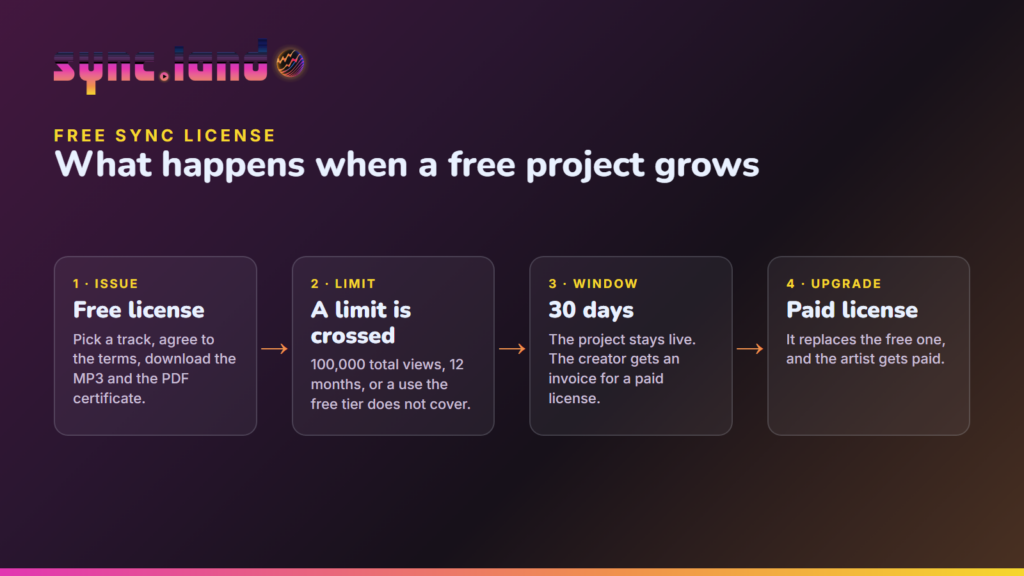
A free license has three limits: 100,000 total views, 12 months, and small-scale use only. Uses such as broadcast, paid advertising and subscription streaming services are outside it from the start.
When a project crosses a limit, the license does not disappear and the video does not come down. A 30-day window opens. The project can stay live during that time, and the creator receives an invoice for a paid license that covers the new scope. Once it is paid, the paid license replaces the free one and the artist gets paid.
We built it this way on purpose. Under a blanket free license with no upgrade step, a video that goes viral pays the artist nothing, forever. Here the upgrade is the point.
Commercial Sync
The paid tier starts at $49 per song, and each artist sets their own price. It covers monetized YouTube, paid ads and sponsored content, independent film, streaming series, paid podcasts, and commercial games. The license is per project and does not expire. There is no credit requirement. You get WAV files, plus stems where the artist has provided them, and a PDF certificate right away.
Custom and exclusive
Some placements do not fit a standard tier: exclusive holds and buyouts, broadcast and television, theatrical releases, major brand campaigns, and large game titles. For those, our team negotiates directly with the rights holder. Start from the licensing page.
What artists keep
- 70% of every paid license. Sync.Land keeps 30%.
- Their other outlets. Licenses are non-exclusive by default, so music can stay on Spotify, Bandcamp or anywhere else.
- Their other royalties. Nothing in the Free Sync License waives public performance royalties, mechanical royalties, neighboring rights or moral rights.
Proof anyone can check
Every license comes with a PDF certificate, which is the document a platform asks for when there is a copyright question. Each one also has a public verification page, so a platform can confirm a license is real without contacting us.
Browse the catalog at sync.land/songs, or read the full terms on the licensing page.
Sources
- Tiers, prices, limits and the upgrade path: the Sync.Land licensing page, which carries the Free Sync License version (1.2, dated September 27, 2026).
- The artist's share: the Sync.Land terms and help pages.
- Verification and the on-chain record: the Sync.Land help pages.