



Valt, one month on: what the first collectors said, and what we fixed upstream

Since August
In August I wrote that Valt was live on Cardano's testnet and asked you to come poke at it. Here is what happened in the weeks since.
- The testing round went in. In early September we shipped Valt's first automated test suite, continuous integration, two security passes, and a feedback instrument that stores what people say. The reports are public at github.com/Awen-online/valt.
- The catalog stayed small on purpose. Two artists, Cullah and Mie, about a dozen songs, nine test mints.
- The first feedback round came back and changed the roadmap. More on that below.
- We found a critical flaw in the wallet layer, not in our code, and got it fixed upstream for everyone. Also below.
- Valt is still on Cardano's pre-production testnet. Nothing on it costs real ADA, and all of it is real code.
What Valt is, and why
Twenty years of releasing my own music. Seventeen albums. No label, no gatekeepers. That model got me here, and it has a ceiling. Streaming rents you access, and the day you stop paying you are locked out. The generic non-fungible token (NFT) went the other way: a token that points at a file and does nothing.
Valt is the middle path. You collect a song as an NFT on Cardano, and holding that token is what opens the artist's Valt: the demos, the unreleased versions, the things an artist only shares with the people who showed up. The gate is real. The exclusive content is withheld on the server and released only to wallets that hold the song NFT. It is not hidden in the browser behind a button.
And the song token lives in the fan's wallet. Not mine, not a platform's. Theirs. It is portable and nobody can take it back. That is the difference between a paywall you rent and a key you own.
What works today
- Server-side token-gating. Access is checked against on-chain ownership on the server, per song.
- A Valt for each artist. A gated fan zone the artist configures from their own dashboard.
- Collecting songs as Cardano NFTs, minted through NMKR, with metadata under Cardano Improvement Proposal 25 (CIP-25).
- An artist dashboard for profile, releases, and media.
- Wallet connect through CardanoPress, using the CIP-30 standard. Desktop browser-extension wallets only for now.
- A public application programming interface (API) for artist discovery, and a follow system so fans can keep up with an artist.
- An in-product feedback survey that stores every response.
I am testing this in public, on my own catalog, because I would rather figure it out alongside other independent musicians than alone.
What the first artists and collectors told us
Five people have completed the survey so far, three artists and two collectors, and the Net Promoter Score (NPS) came out at +60: three promoters, two passives, no detractors. Five responses is a direction, not a statistic, and I am not going to dress it up as more than that.
The one finding that changed the roadmap was fractional ownership, the idea that early fans share in a song's future earnings. All three artists rated it five out of five. The collectors split: one loved it, one wanted nothing to do with it. In August the copy said the upside gets shared back to fans. I want to be more careful than that now. Revenue share is not switched on. When it comes it will be opt-in and configured by the artist, not a default every fan has to accept, because that is what the people we asked told us. The collectors also asked for mobile wallets, local-currency pricing, and a cheaper way in. All three are on the list below.
The CardanoPress disclosure
When ownership is the key, the lock has to hold. While hardening Valt's own wallet login, we traced the wallet-authentication path end to end. That review turned up a critical flaw, not in our code but in CardanoPress, the open-source WordPress component many Cardano sites use for CIP-30 wallet connection. Its class is an authentication bypass in the wallet login flow. That is as far as I am going to describe it; the release notes say what needs saying.
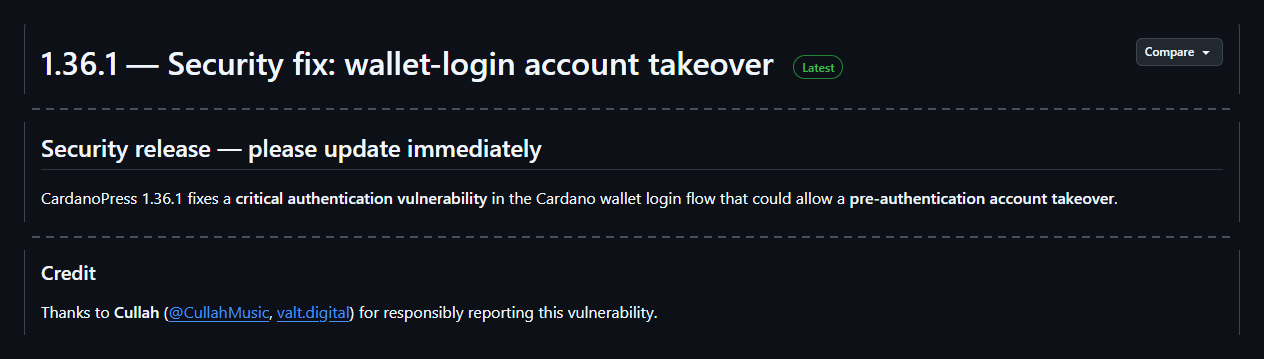
We reported it privately, with what the maintainer needed to confirm and fix it, and ran a first-party mitigation on our own install in the meantime. The maintainer responded quickly. CardanoPress 1.36.1 shipped as a security release, and the notes credit Cullah and valt.digital for the report.
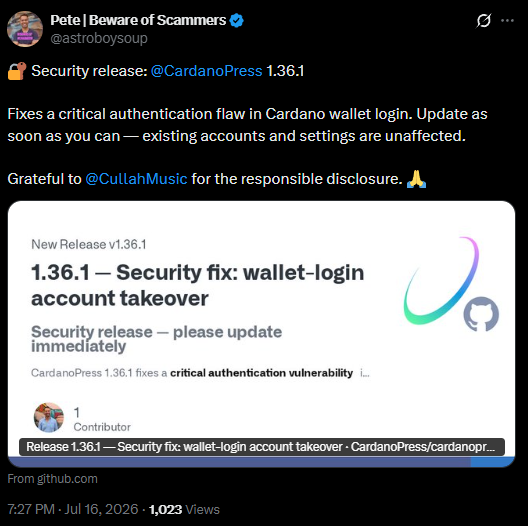
The maintainer also said so publicly.
We are not publishing the details. The point of disclosure is to get things fixed, not to hand out a recipe. A fix in a shared component protects every site that uses it, which is the whole reason to do it this way. If you run CardanoPress wallet login on your own site, update to 1.36.1 or later.
What is next
Next, in rough order: mobile wallet support; local-currency pricing and a cheaper way in; full music metadata under CIP-60 (CIP-25 today); and an independent third-party security review of minting and gating, which is forthcoming and which I will not call an audit until it has happened. Mainnet comes when the review is done and the gate has held up under real use, not before.
Further out is the direction the survey confirmed. We are working toward a cooperative model where artists and the fans who back them are members with a real stake in the work, with revenue share the artist switches on and configures. None of it is on in the product yet, and it will be labeled clearly when it is.
Come and look
If you collect music, start at valt.digital. If you make it, valt.digital/for-artists is where you apply. And tell us what is working and what is not at valt.digital/feedback. The last five responses already changed the roadmap. Thank you for being early.
Ian McCullough
Principal, Awen