After years of development, community building, and blockchain innovation, Sync.Land is officially live — and it’s set to change the way music gets licensed forever.
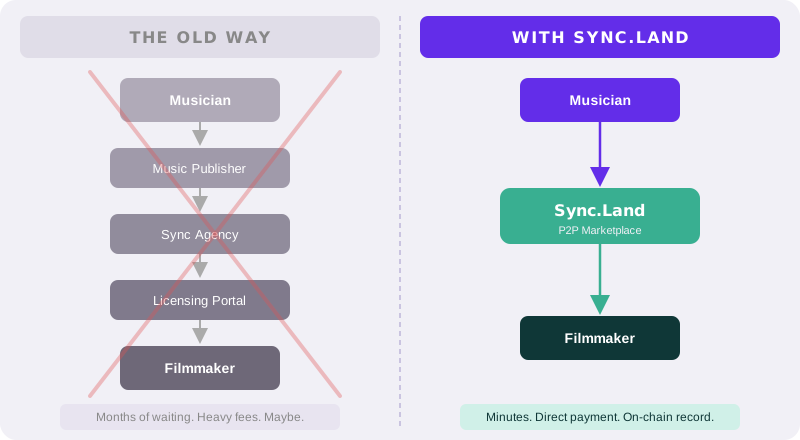
Built by Awen, the Milwaukee-based creative agency at the intersection of music, technology, and Web3, Sync.Land is a peer-to-peer marketplace for synchronization licenses — the agreements that allow music to be legally paired with film, video games, and other visual media. No middlemen. No predatory agencies. No waiting months for a check that may never come.
The Problem with Sync Licensing (Until Now)
Getting a sync license has always been broken. Musicians face opaque agencies that take enormous cuts, delayed payments, and zero transparency. Filmmakers and indie game developers face a slow, expensive, and legally murky process just to use a song. The sync industry runs on gatekeepers — and Sync.Land removes them entirely.
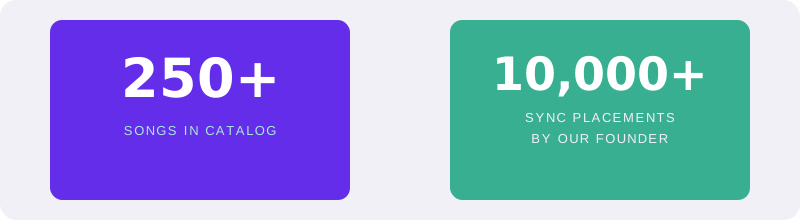
With 250+ songs already in the catalog, rights holders set their own terms: territory, duration, type of use, and price. Payments go directly to musicians. Deals close in minutes, not months.
From freemusic.land to Sync.Land
Sync.Land’s roots trace back to freemusic.land, a Web2 proof-of-concept platform launched by Awen founder Ian “Cullah” McCullough in 2021. Cullah — a Milwaukee-born musician who has released open-source music annually since 2006 and personally placed his tracks in over 10,000 projects — built freemusic.land to prove the demand was real. It worked. Now that catalog and community has fully transitioned to Sync.Land, leveling up the platform with blockchain infrastructure, smarter licensing tools, and real revenue for artists.
Creative Commons Meets Commercial Licensing
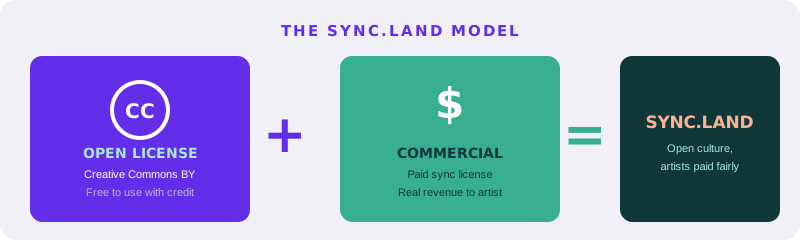
One of Sync.Land’s most powerful features is artist choice. Musicians can opt to list their music under a Creative Commons Attribution (CC BY) license — the same philosophy that drove the open-source music movement — while still earning revenue. The key distinction: these are paid commercial sync licenses. When a filmmaker, game developer, or content creator uses a song from Sync.Land, the artist gets paid. CC BY doesn’t mean free anymore — it means free to use with fair compensation flowing directly back to the creator.
This model honors the open culture ethos while finally making it financially sustainable for musicians to participate in it.
NFTs as the Future of Sync Verification
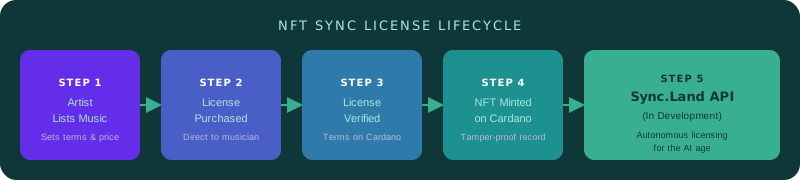
Thanks to support from Project Catalyst — Cardano’s decentralized community innovation fund — and the broader Cardano ecosystem, Sync.Land is pioneering something the industry has never seen: NFTs as verifiable sync license certificates.
When a sync license is issued on Sync.Land, it can be minted as an NFT on the Cardano blockchain — a permanent, tamper-proof, on-chain record of who licensed what, when, and under what terms. This isn’t just a receipt. It’s the foundation for an entirely new economy: a microsync agentic future where AI agents and autonomous systems can discover, license, and pay for music in real time — without any human in the loop.
The music industry is about to meet the age of autonomous AI — and Sync.Land is building the infrastructure to make sure artists get paid when it does. Our API, currently in active development, will enable this autonomous licensing layer directly.
Funded by the Community
Sync.Land was selected and funded through Project Catalyst Fund 11, with the full codebase released as open source under the MIT license. The protocol belongs to the community — not a corporation.
This isn’t just a product launch. It’s the culmination of a movement to return music rights — and music revenue — to the artists who create them.